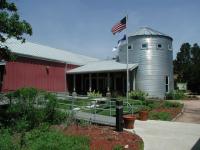
McKinney Roughs includes an extensive learning center and hosts many school groups to teach children about the environment.
McKinney Roughs is located right on Hwy. 71 between
Austin and Bastrop. From Austin, head east on Hwy. 71 past Austin Bergstom International
Airport. Proceed for about 10-15 miles and look for the park's distinctive rock wall
entrance with windmill on the left. Hiker check in is at the LCRA Office near the main
parking area.
The Hike: McKinney Roughs contains the most extensive collection of hiking trails to be found in Central Texas. The official park website mentions over 15 miles of trails, with more planned in the future.
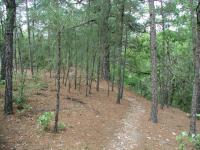
Pine needles litter the path of some of the trail. McKinney Roughs is on the edge of the Lost Pines.
All trails start at the waypoint marked "Trailhead" on the map. The exceptions to this are the two Equestrian trailheads that lie near the northwest and southeast corners of the park (not yet mapped). This main hiking trailhead is behind the red Environmental Learning Center building.
The easiest trail in the park, the Ridge Trail is shown on the topo map in blue to make it easy to find. The trail is mostly flat with a smooth surface of crushed granite. Someone was in the process of creating an interpretive trail guide for this path during my last visit and I was able to borrow an advance copy to take along. Unlike many interpretive guides, this one went into some interesting details about the coexistence and synergy between many of the species and plants and animals that call McKinney Roughs home.
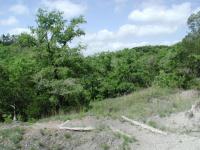
The trails of McKinney Roughs undulate up and down hillsides.
The remaining trails are a criss-crossed collection of full and partial loops that provide ways to craft almost any type of hike you could want. The trail surfaces consist of rocky hardpack in the uplands and dirt and occasionally sand along the river's edge.
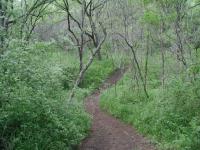
As the trail lowered to the Colorado River the extra moisture fed a thick carpet of greenery.
Most of the tree cover at McKinney Roughs consists of the Juniper-Oak combination that is commonly found throughout the hillcountry to the west. But this land is on the very outer edges of the Lost Pines area and some stands of pine can be found, particularly on the east side of the park.
Flat portions of the trails are often marked by pocket prairies. These spots of open land
are a treasure trove of wildflowers. One of the better areas for wildflowers of all
varieties was the pocket prairie along the Bobcat Ridge trail just west of the main entrance driveway.
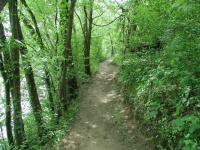
The trail follows along the bank of the river for about a mile.
As trails descend to the river the surrounding vegetation closes in on it. The path narrows considerably and the wildflowers disappear. Instead the ground is covered in a thick carpeting of various grasses, all very green.
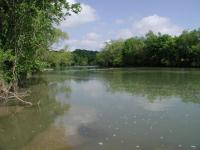
The Colorado River as seen from the trail.
Most of the trails at McKinney Roughs allow for horseback riding. If being near an occasional horse is intimidating you can avoid them altogether by limiting your hike to the Ridge, Woodland, Cypress, Pine Ridge, Valley View and Bluff Loop trails. These total over 5 miles, approximately one third of the park's total trail system.
Don't be afraid of the horses and let a majority of the park go unhiked! When coming up on a horse and rider, stand on the side of the trail motionless and gently chat with the riders as they pass by. As has always been my experience at McKinney Roughs, the riders are friendly and considerate.
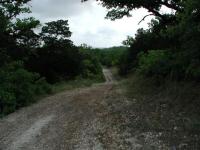
Some portions of the paths are old jeep trails.
The trails on some of my visits had an unfortunate trait that I had not anticipated - cobwebs. Lots of them. Spiders find that by spanning a sticky web across a open area like a trail they can capture more frequent meals. What it meant for me was a frequent brushing of my arms and legs to free myself from the web's snare. Eventually I adopted a long branch, which when waved in front of my direction like a royal sceptor cut down on the number of web collisions. But sometimes the method served only to break the silky stand, which willowed in the wind and stuck to the first available object, often my clothes or skin.
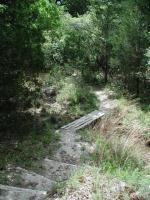
No creek crossing on the trail presents any problems and often includes a bridge, such as this one.
Added to the spider webs were catepillar strands. Hanging under oaks like bungee jumpers
the little green guys contributed to making the going slow as I tried my best to clear a
path. I'm sure that fellow hikers who followed my path later in the day reported far fewer web encounters. Don't let this tidbit scare you. Spring is bound to include more activity with respect to spider webs and caterpillar strands. Hiking at different times of the year may avoid this
hassle.
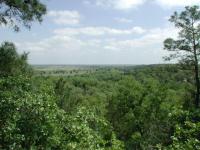
Further uphill there are several magnificent views of the Colorado River below. Note the farmland on the flatter land on the opposite side of the river.
A wonderful view of the Colorado River is available at the waypoint "Overlook". The view shows some of the contrasts in the land here. To the right of the river the hilly terrain continues and is heavily forested. On the opposite bank the land is relatively flat and since it is more conducive to being farmed it has been cleared.
The McKinney Roughs trail map does not make any mention of ranch ruins along the trail.
According to the information center the property was a working ranch having first been
settled by John Wise and his family in the 1850's. The Wise family continued to live on
the property up until the 1950's when the family home burned down. The remains of a corral can be seen at the waypoint "Corral" and what may be the location of the Wise home can be found along the trail not too far afterward. All that remains of the home now is a concrete slab and chimney.
Although McKinney Roughs bears the name of Thomas McKinney, there is no proof
that he either lived there nor owned any of the land. However, he did own a
lumber mill across the river and may have used some of the trees cut down within
the boundaries of the current park.
Though somewhat saddened by the sale of the northern half of the park, McKinney Roughs remains a prime hiking destination in the central Texas area. The complex system of trails can be difficult to comprehend in the beginning but provide a plethora of options that allow visitors to set up exactly the kind of hike that they desire.